


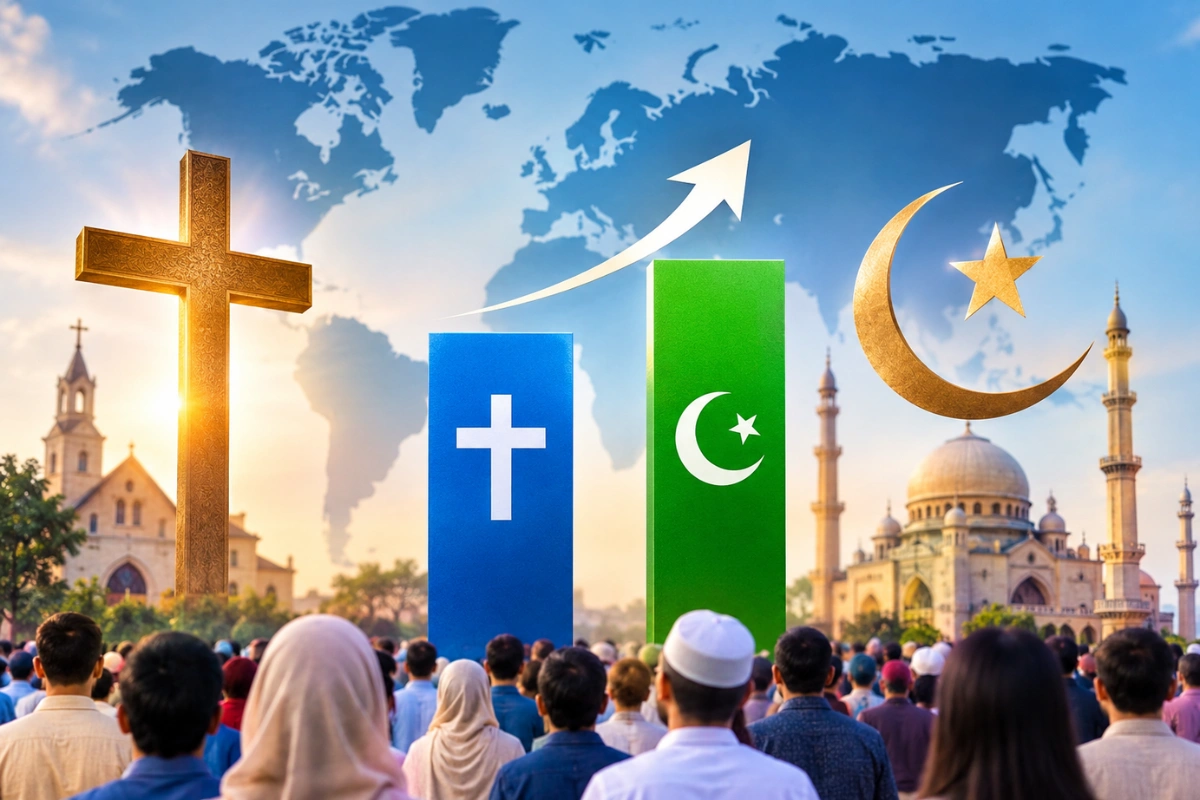
The Pew Research Center has forecast that Islam will overtake Christianity by 2035 to become the world’s largest religion by number of followers, a shift largely attributed to differences in birth rates and population demographics between the two religious groups.
According to the centre’s latest report, published on Wednesday, 18 November, the global Muslim population is expected to reach about 2.57 billion by 2035, compared with an estimated 2.52 billion Christians. The figures suggest Muslims could surpass Christians in population for the first time in centuries.
Pew estimates that there were about 2.02 billion Muslims and 2.27 billion Christians worldwide in 2020. However, the Muslim population has been growing at a faster rate, and researchers expect the trend to continue over the coming decades.
One of the main factors behind the projected shift is the higher birth rate among Muslims. According to the centre, Muslim women had an average of 3.1 children between 2020 and 2025, compared with 2.5 among Christian women and 1.6 among women belonging to other religious groups.
Pew says natural population growth – the difference between births and deaths – is the main driver of the increase in the number of Muslims and Christians, while religious conversion has a comparatively smaller impact. Both religious groups are expected to grow, but the Muslim population is projected to increase more rapidly.
The report also forecasts that, if current trends continue, the number of Muslims worldwide will exceed 3.6 billion by 2070, while the Christian population will reach about three billion. Muslims would then account for roughly 37 per cent of the global population, compared with around 29 per cent for Christians.
The study examines religious demographic changes across 201 countries and territories, taking into account factors including population age, fertility, mortality, migration and changes in religious affiliation.
Researchers stress that Islam overtaking Christianity in population size would not mean a decline in the number of Christians or widespread conversion to Islam. Rather, both populations are expected to grow, with differences in their rates of growth driving the projected change in their global ranking.
The projections suggest much of the growth in both Muslim and Christian populations will occur in regions where the religions already have large followings, particularly sub-Saharan Africa, where birth rates remain relatively high and populations are expanding.